So in this episode I’m going to talk about the Next Generation Squad Weapons Program to replace the M4 and M249 SAW. If there’s anything I’ve learned in my time in the military it’s that Soldiers hate two things, change and the way things are. And it seems like ever since the new M7 rifles were selected as the new rifle, a lot of people especially on social media have talked about how negative this switch is going to be for the troops, citing mostly the weight of the rifle and the ammunition. Now, I’m a big numbers guy so I wanted to run the numbers and see what the actual weight change is going to be, going to a heavier weapon and heavier round. And I’m going to be talking about it in the context of mountain infantry.
So first let’s talk about the way things are right now in a Light or Mountain Infantry Platoon before any of the new changes. This is probably a review for most people listening but it’s going to work into my points later. So we’ll start with the smallest group which is a fire team of 4 Soldiers. You have a rifleman with an M4 carbine. The M4 carbine shoots a 5.56 round, each magazine holds 30 rounds, and the typical “combat load out” is seven magazines for a total of 210 rounds carried on the body.
The second soldier in the fire team is a grenadier who also has an M4 with a full combat loadout but also carries a m320 grenade launcher with 12 40mm grenades. This grenade launcher is often attached to the bottom side of the rifle, though it can be detached and used in a standalone configuration which we’ll talk about later.
The third Soldier in the fireteam is the automatic rifleman who carries the M249 Squad Automatic Weapon or SAW for short. This “light” machine gun fires ammunition that’s linked together in 200 round plastic drums that get attached to the SAW but you can break them up into smaller lengths and commonly, the gunner will walk around with 100 linked rounds loaded into a pouch usually referred to as a nutsack loaded in the gun to make the overall gun a little lighter and easier to manage.
These three soldiers are then controlled by the Fire Team leader, who also carries an M4 carbine. This allows at the lowest level some form of fire and maneuver because you can shoot and move in pairs, and typically when paired off like this, the SAW gunner will stay with the Team Leader because the SAW is seen as the main source of firepower at the team level. Two of these 4 person teams are under a squad leader with an M4, making a 9 person Line Squad.
The most recent change I have seen to these squads is that they’ll give one of the riflemen in the squad an M110A1 rifle, which is a more precision/distance oriented rifle that fires a 7.62 round. This person is often referred to as the Squad Designated Marksman or SDM and in theory they are supposed to receive some more specialized training on distance shooting.
In a platoon, there are 3 of these line squads, plus a weapons squad. This firepower of the weapons squad is the gunner who is carrying the M240 Medium Machine Gun which also fires the 7.62 round. The gunner will also have an assistant machine gunner / ammo bearer to help carry extra ammunition, a spare barrel for the machine gun, and a tripod to mount the gun on. This assistant machine gunner carries a lot of weight for the machine gun but they themselves carry an M4. Usually there’s two of these machine gun teams in the weapons squad and in my experience, the rest of the weapons squad is sort of modular depending on what the mission is. Sometimes there will be a two-person team carrying the Javelin Missile System, sometimes they’re carrying a Gustaf Recoilless Rifle, but either way it is a heavy weapons system carried by two people who are also carrying an M4 carbine. This squad is all under the control of the Weapons Squad Leader, sometimes called the Weasel WSL for short. As a side note this is supposed to be the most experienced squad leader because of all the different weapon systems they needs to control.
Plus the PL, PSG, both carrying M4’s. Common attachments to the platoon include the Radio Telephone Operator (RTO), and a combat medic who both carry m4 rifles.
This means in a typical light infantry platoon there are:
21 M4s
6 Grenadiers
6 m249 SAWs
3 DMRs
2 m240s
Where did the NGSW come from? Well in 2017 the Army issued out the specs they wanted for a new weapons program to replace the current infantry weapons and they specifically chose the 6.8 round to replace the current 5.56. Typically rounds are named for their bullet diameter so obviously the bullet the army wanted to switch to is bigger that what it currently uses. And the reason they gave was body armor penetration at distance. Right now the standard body armor worn by the US military are Level 4 SAPI plates. SAPI is an acronym that stands for Small Army Protective Insert, and they are ceramic plates that get inserted into a vest, front and back, made to protect vital organs, and occasionally soldiers are given side plates as well that protect from the top of the hip bone to the bottom of the lat. These level 4 plates protect from both 5.56 and 7.62 rounds so the idea is that this new 6.8 round will be able to penetrate the armor since it is a heavier bullet than the 5.56 and moving at a faster speed than the 7.62 with a more efficient shape for penetrating armor and barriers.
Drawback of the M4 from least to most important
- Fixed front sight post that attaches to the front handguard = non-free floating barrel. You have to be careful if you are supporting it on something or using a bipod when you shoot to not put too much input into that forend or it will very slightly push on the end of the barrel and very slightly effect where that bullet will go.
- Direct impingement, which means the gasses from the fired round are then sent back directly to the bolt carrier to cycle the action, eject the spent bullet casing and load the next round. It’s a reliable design but it causes a lot of carbon buildup in the bolt carrier group, because thats where the gases are going. On top of that, if you are using a suppressor, this can cause a lot of gas in the shooter’s face because the suppressor slows down any gas exiting the barrel and forces more gas back into the bolt carrier group and out of the ejection port. This gas irritates the shooter’s nose and eyes and is obviously distracting when they’re trying to focus on fighting. Now, I don’t think suppressors are necessary for every soldier carrying a rifle but I’ll talk about that later on when I get to my recommendations.
- 14.5 inch barrel. 5.56 external and terminal ballistics. Especially in the mountains where you have long sight lines and fast moving wind, the 5.56 is pretty easily affected by the wind. I was at a course in the Caucasus Mountains of Georgia and even at just 300 meters with the wind that we were experiencing I had to aim a whole body-width to the right of a silhouette target so the wind could blow the bullet mid flight to the left and land within the target. If right before I shot, the wind stopped, then I would have missed to the right and if the wind picked up, I’d miss to the left. This isn’t a problem unique to the mountains but it is definitely amplified. Now, you could switch to a heavier bullet. I believe we were shooting 55gr bullets. And you could go up to 77gr, a bit heavier so it would have more bullet drop over distance.
- So let’s talk about bullet drop. A 5.56 bullet of any grain weight loses speed quickly. Generally, after 300 meters, it loses about ⅓ of it’s velocity so gravity essentially has more time to pull it down to the ground as it travels through the air. What does this mean in practical terms? Your range estimation needs to be more precise in order to not miss high or low, when compared to flatter shooting bullets that retain their velocity as it travels through the air.
- Now, speaking of retained velocity, the 5.56 round is relatively small and light, relies on velocity to actually do tissue damage. To put it in perspective, most deer hunters would never use a bullet that small because you’d have to have a very precise shot to the vital organs and be within 200 yards to make sure it still had enough velocity to cause enough damage to the body. Now take that line of thinking and apply it to an enemy soldier wearing armor that covers their vital organs. This lines up with a study called “Increasing Small Arms Lethality in Afghanistan: Taking Back the Infantry Half-Kilometer” written in 2009, it actually comes to the same conclusion of 200 yards being the limit of the 5.56 cartridge.
Okay, so what has the Marine Corps done about this? They replaced their M4 carbines with the M27 Infantry Automatic Rifle and this fixed the first couple of the problems with the m4.
M27 IAR
- Free Float barrel so now using a bipod or pushing against a barrier won’t mechanically affect the accuracy.
- Short stroke piston operated, so gas pushes a piston to reciprocate the internals and load the next round. That keeps the internals a little cleaner and gas isn’t being pushed back into the shooter’s face when suppressed.
- However, it still uses the 5.56 round. It has a slightly longer barrel length of 16.5 inch barrel so in theory it has slightly faster velocity coming out of the barrel but like we said earlier, 5.56 loses velocity fast.
The Army’s solution was the 6.8 round and the M7 rifle. We’ll talk machine guns in a minute but what does the M7 do for us.
M7 Rifle
- Free Float Barrel
- Short stroke Piston operated
- Fires the 6.8×51 round.
- What does this do for us? It fires a bullet that is similar to the 7.62 in weight but at a speed similar to the fast traveling 5.56. How? By redesigning the entire round and rifle to handle increased chamber pressure. Also the bullet is a more efficient shape. What are the practical advantages? It’s hard to know exactly because the military isn’t going to let everyone know the limits of their new equipment. But from what we can tell, it’s less effected by wind, flatter shooting, and can either currently or in the future penetrate modern body armor.
- Sounds great but there are some drawbacks.
- Originally 9.4 lbs unloaded for a 13 inch barrel. Very heavy compared to a 6.6 lb unloaded M4. Unloaded means not just no magazine but also nothing attached like sighting system, lights, lasers, ect.
- So 9.4 lbs was not great. But within a couple months they announced an updated version of the gun with a shorter barrel and other weight saving features that equated to a 7.3 lbs for 10.5 inch barrel. So not only lighter but also slightly more maneuverable. Okay that’s one problem solved.
- The next problem is harder to solve, and that is ammo capacity. Because it is a larger round, less of them can fit in a magazine of the same size. The standard magazine size for the 6.8 is 20 rounds instead of the 5.56’s 30 rounds. Well naturally you’d think to just carry more magazines, but the other problem is that the heavier 6.8 round although slightly lighter than 7.62, weighs about double that of a 5.56 round.
- And therein lies one of the biggest complaints of the whole NGSW Program.
But the M7 rifle is only half of the NGSW program, the other half is the M50 Machine Gun set to replace the M249 SAW. I was a SAW gunner for a couple of years including a rotation at JRTC, (Army people will know what that is) so I can attest to the love-hate relationship soldiers have with this machine gun.
Drawbacks of the M249 SAW
- If you didn’t know, the SAW unloaded weighs 17 lbs and the gunner is supposed to maneuver with the rest of the squad. M4’s have weight saving cuts, and metal milled out to make it lighter and more ergonomic, meanwhile the SAW looks like it has spot welds on it. So you’re carrying a gun that is double the weight of an M4, but the 5.56 bullet is doing the same thing it does coming out of an M4, you just have more of them.
- Typically ammunition is issued in 200 round linked belts in a plastic drum that weights 5lbs, so if you load that 200 round drum, you now have a 22lb gun. So everyone was just complaining about the 10lb M7, and we have a bunch of teanagers hauling around 22 lb guns. Like I mentioned earlier, most of the time, the gunner will split that belt in half and only load a 100 round “starter belt” using a pouch and that reduces the weight by a few pounds.
- The next thing is slow reloads. You basically have to put it on the ground and use two hands to open the feed tray cover, put the new belt in and hold the belt in place as you close the cover again. It’s very easy for the belt of ammunition to become misaligned in that process and the first time you try to fire from that new belt of ammunition, the bolt slams forward but doesn’t fire because the rounds are misaligned in there.
- The next issue is the safety, its a cross bolt safety which means you push the button in on the left side and its on fire. That causes that button to now stick out on the right side of the gun. You push the button in on the right side and it goes back on safe. The problem with that is that it’s slow, and the second problem with that is its the reverse direction of what a lefty would want. So you end up with the choice especially in close quarters, do I leave it on safe and have it take an extra half second to hit the safety if I need to fire? A half second could be a lot of time in close quarters. Or I’ve seen people do the wrong answer, which is leave it on fire when coming around a corner so they don’t even have to worry about the safety if they need to shoot, they just pull the trigger. Obviously, that goes against the major rule of weapons safety that we teach but that safety is so hard to use that that’s what people tend to do.
- Only fires in full auto. Well when we’re talking about preserving ammunition and making what you are carrying last longer, maybe you want to use suppressive fire to keep an enemy’s heads or distracted as others maneuver. Potentially single shots could do that job without ripping 3-5 rounds every trigger squeeze. The other reason single shot is useful is masking your capabilities. I can tell you from a scout’s perspective when we are probing a defensive position, our job is to collect information and get close enough to get the enemy to show their hand. At least Army doctrine has the machine guns at the end or apex of their defensive lines. So if you know you’re fighting a platoon, and you can basically bait a machine gun into firing, you can confidently make some assumptions. On the flip side of that, when WE were in defensive positions, we have to make clear to our machine gunners to only fire if the situation meets a certain criteria that would make it worth it to show our hand, whether its only fire at groups of 5 or more, only shoot at vehicles, crew served weapons, ect. This leads to situations where a machine gunner may see an enemy or two but then has to try and communicate that to someone with a rifle to then shoot at what he is seeing because that threat doesn’t meet the threshold of machine gun fire yet.
- And the last issue is those plastic 200 round drums get really brittle in extreme cold, as you could imagine. They shatter and then you end up dragging the belt. I understand the thought process behind the drum but I’m pretty sure everyone would just prefer the nylon pouches.
So how does the M250 solve these problems?
M250 MG
- It’s lighter @14.5lbs, 50 rd pouch 3.5 lbs, 100lb pouch = 6.75lbs. So if you patrol with a 50 round pouch, you’re lighter than an loaded SAW.
- The reloads look quicker and easier with the feed try opening to the side and actually having something that grabs the first round and holds it in place while you close the cover. I know theres multiple ways to feed a new belt in, but that feature is huge.
- And it has a more modern safety selector like the M4 and M7 so it is quick and easy to switch back and forth that there is zero reason at this point for people not to use it.
- It can be fired in semi-auto so you can actually conserve ammo and not give away key positions.
So what’s the downsides of the M250? Same as the M7, weight. And that’s what sparked me to want to run some numbers and see what the weight difference really is. Let’s look back at the makeup of the platoon:
21 M4s
6 Grenadiers
6 m249 SAWs
3 DMRs
2 m240s
Lets go back to the Marine Corps real quick, they actually don’t have dedicated light machine guns at the team or squad level anymore. Basically everyone in the 13 person squad has a M27 rifle which is capable of automatic fire, and then the M240 medium machine guns are in a separate heavy weapons platoon that can get detached out to squads that want or need them. So basically the Marine Corps solution was to get rid of the SAW in the infantry platoon and one person per fireteam will be designated the Automatic Rifleman and carry extra ammunition to fill that role. So we see the 2 different schools of thought at play here. The Marine corps took the heaviest weapons in the platoon away and made a lighter but less capable platoon. The Army replaced their lightest weapon with something more capable and are evening out their weight closer to the machine gunners. So lets actually analyze the weight.
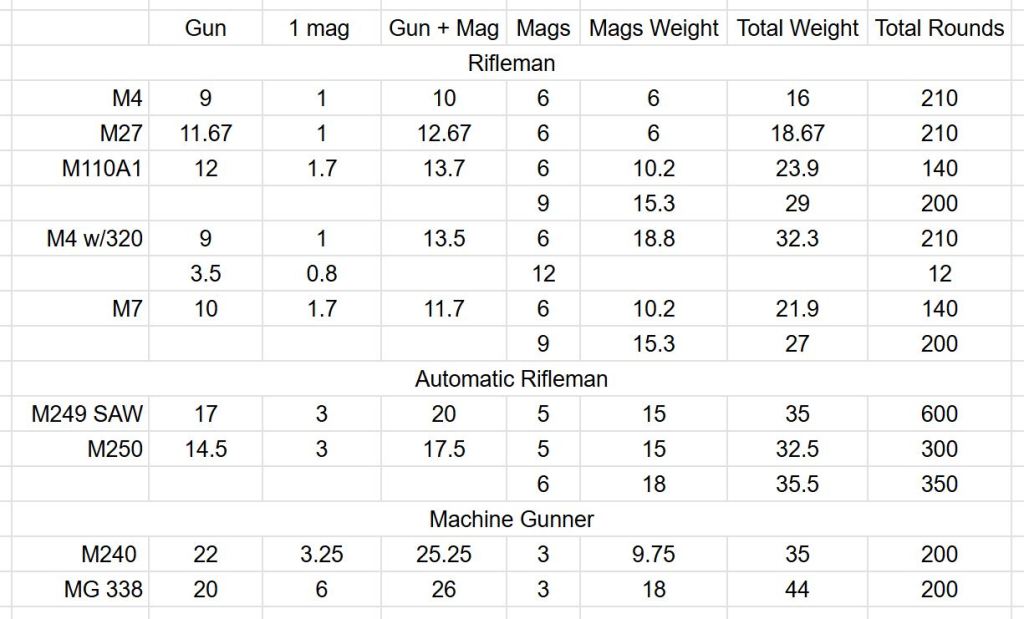
Let’s start with an M4. An M4 with an ACOG and PEQ-15 weighs 9 lbs, plus a 30 round magazine is 10lbs. If we’re considering 210 round or 7 magazines as a combat load then lets add 6 more magazines for a combat load and we have a total of 16 pounds for weapon and ammunition.
How about the Marine Corps M27? WIth it’s VCOG scope, PEQ-16, it weights 11.5 pounds, plus a magazine is 12.6 pounds. Plus the 6 more magazines makes a total combat load of 18.6 lbs. So the Marine Corps solution is a slightly heavier gun, and keep in mind some of them will be carrying a lot more ammunition as the automatic riflemen.
The new lighter M7 is 7.3 lbs plus the new laser and optic brings it to about 10 lbs, plus 1.7 pounds for the 20 round magazine makes it an 11.7 pound gun when loaded. Plus 6 magazines, brings it up to 21, almost 22 lbs. That’s an extra 6 lbs for a third less ammunition. What if we bump that up to carrying 9 extra magazines to give us a 200 round combat load of 27 lbs. Why 200 instead of 210? I’ll talk about that later.
So that’s 27 lbs for the new M7 versus the legacy M4 of only 16 lbs. You’re probably thinking “That’s 11 more pounds!” Thats correct. How could anyone possibly move around on foot, let alone in the mountains when their weapon weighs almost 12 pounds and their combat load of weapon plus ammo weighs almost 30 lbs?! That’s a great question, lets move on to the other weapon systems.
Lets talk about the 6 grenadiers. They have an M4 with a 3.5 lb M320 grenade launcher attached to the front of it. That makes the weapon weigh 13.5 lbs and a lot of that weight is on the front of the weapon so that makes it front heavy and actually hard to shoot in any position. Even when shooting off a barricade it wants to roll left or right so it’s hard to keep steady. Okay so lets add the combat load of 6 magazines and 12 40mm grenades that weigh .8 pounds each. That all adds up to a combat load of 32.3 pounds.
Just a reminder, the M7 with 200 rounds was 11.7 pound gun and 27 pounds combat load.
The m4 Grenadier with had a 13.5 pound gun and a 32.3 pound combat load
What does the grenadier look like with the M7? Well, I don’t know if there are plans to make the 320 able to attach to the underside of the M7, but if it did, that would make the weapon 15 lbs. Plus 6 magazines would make a total combat weight of 38 lbs. But carrying 9 extra magazines for a total of 200 rounds of 6.8 and 12 40mm grenades would be a total of 43 lbs. To be honest, that is a lot of firepower and I’m going to speak to that later on in my recommendations.
So far everyone in the platoon’s weight has gone up, in exchange for the increased capability.
But let’s talk about the DMR role and the M110A1 there’s 3 of them in the platoon. With an optic and suppressor and bipod the gun weighs 13lbs, plus a 1.7 pound magazine that makes a 14.7 lb rifle fully loaded. Add 6 more magazines and that is 23.9 lbs compared to the 21.9 pounds for the M7 with the same number of rounds. Lets bump that up to the full combat load of 200 and that 29 lbs for the M110A1 instead of the 27 for the M7. For for the M7, you have a lighter gun and lighter ammunition for increased performance over the M110A1 chambered in 7.62.
Okay lets keep going and talk about the machine guns.
The SAW which there is 6 in the platoon weighs 17 lbs, plus 3 pounds for the 100 round pouch, that makes the weapon weigh 20 lbs. Plus 500 additional rounds for a total of 600 rounds would bring the weight up to a total of 35lbs. So that’s 20lb gun, 35lb full combat load.
The M240 which there is 2 in the platoon weighs 22 pounds, plus 3.25 lbs for a 50 round “starter blet” thats a little over 25 lbs. And If they carried 500 rounds that would add an extra 32 pounds for a full combat load of 57 almost 58 lbs. Obviously that’s not realistic and that would be distributed to the ammo bearer/team leader. Usually they carry 200 total rounds on them which would total a full combat load of 35 lbs.
The new M250 itself weighs 14.5 lbs plus a 3 lb 50 round starter belt. So thats a 17.5 lb gun compared to the 20lb SAW. So it can maneuver a little easier than the SAW, but the ammo is heavier. If we want to keep weight of the combat load the same as the SAW (35lbs), that would mean carrying only 350 rounds as compared to 600 rounds for the SAW. I think that’s actually a fair trade off due to it’s ability to fire in semi auto. You could even potentially range with single shots before switching to auto.
Now this is where the Army needs to figure some stuff out, because we see the M250 is lighter than the SAW but has the capabilities that exceed the M240. So is the platoon going to get restructured? Or are we going to adapt the MG338, the bigger version if the M250 that fires a larger round, as a replacement for the M240?
So those are the numbers, Is the NGSW heavier? For some in the infantry platoon, yes, but also gain capability
Let’s talk about some of the other criticisms I’ve heard of the M7 specifically.
The first one that I heard from a prominent youtuber was “We’ll only engage enemies 300y and closer? Look at these studies WW2, Korea, and Russia/Ukraine. You cant even identify an enemy past 300 yards and even if you could, soldiers don’t have enough skill to make that shot.”.
That’s speculative and also terrain dependent. I’m looking at this through the lens of mountain warfare where you’ll definitely have sightlines at distance. But in WW2 and Korea, magnified optics weren’t anywhere near as common on weapons as they are now. So thats kind of a silly thing to bring up. Next is using Russia/Ukraine as evidence that all future warfare is going to be close range. Other people have dove deep into this topic but a majority of rifles on both sides only have iron sights, whether its lack of funding, how quick both sides have to crank out these conscript soldiers, and the fact that these fights end up being a lot of trench warfare around urban centers and no major breakout in either direction. I don’t think that is representative of how the US military fights, or how every future conflict is going to be fought.
On the skill argument, I can tell you having shot with many classes of students on the high angle range at mountain warfare school, everyone can hit a silhouette at 300 meters. The farthest I’ve personally seen a student hit a silhouette with an M4 and ACOG is 800 meters, but most go out to 5 or 600. But as you can imagine, it really depends on the wind, and you’re lobbing them in and barely hearing or seeing any feedback from the steel target because the bullet has lost so much energy. But it can be done, with a little bit of training soldiers can hit a 2 MOA target at 800 meters. Do they need to? Not necessarily but in the mountains that is a very useful skill to have.
The next criticism I heard is that because it’s heavy, it is hard to shoot while standing, but hard to control in full auto. And obviously that’s the first thing people do when they pick up a rifle is they shoulder it and aim at the wall and see how long they can hold it up. And there’s a couple things there
First is that, like I already talked about earlier, we already have weapons that are significantly heavier than the M7 that we can shoot standing up. Secondly, firing off hand which is the term for saying standing and unsupported isn’t really the way we train to fight. Right? We’re taught to get on line facing the threat and return fire from behind cover. If there’s no cover around you, you go prone to make yourself as small of a target. And even less common than firing while standing straight up is doing so while firing full auto and needing all your shots to be within a single target. I could see that for breaking contact or CQB, but in a mountain warfare scenario I don’t see that being a priority.
The next thing I’ve heard people say is
How are we going to get the x-ray technicians and admin personnel to shoot a heavier rifle?! And to that I say this, they probably currently only shoot once a year to have weapons qualification on paper anyway and if they’d fail weapons qual with an M7, they’d probably also fail with an M4 anyway. Our weapons qualification emphasizes shooting in the prone and off barriers which is not the type shooting that a heavier weapon would hinder. If people are failing weapons qualifications, my opinion is it’s a skill issue rather than the weight of the rifle.
We shouldn’t give our combat arms soldiers a weaker rifle just because our support personnel couldn’t handle a more powerful one. Just give the support soldiers pistols (along with better pistol training) and move on with it.
The next thing I hear people cite is the “just get fit” fallacy, as if we think going to the gym and hitting arms will produce more effective shooters. When I talk about fitness in the infantry I’m not talking about shoulders and biceps, I’m talking about legs, core, lower back, zone 2 cardio. Around 50% of the Army’s total infantry are in the National Guard, and it’s hard to just roll off the couch once a month and do infantry stuff, its even harder to do that in the mountains. And as I hopefully laid out for you earlier with the numbers, NGSW or not, people in the platoon are carrying 35 lbs of just weapon and ammo. So yes, go to the gym, strengthen the lower back, strengthen your legs, work on your cardio, and on the days those body parts are recovering, hit those shoulders and biceps.
A platoon can only move as fast as the slowest person, and that’s usually the machine gunners. I learned this the hard way when I was a team leader, well not hard for me hard for other people. I was an Alpha Team Leader for first squad so basically I was the first person leading this training patrol and I led us uphill and I would turn around every couple steps and some people just looked more and more exhausted the farther up we went. In my head I’m thinking I can run up this hill right now and people are exhausted just walking. But really it was two fold, yes I might have been in better shape but also some people are carrying more weight.
Then I learned some of these tricks from mountain guides. The first one is it is overall faster and less exhausting to go at a slower pace and take fewer breaks. If you work someone to their absolute limit, it is going to take them a while to recover. So you can work people hard for 30 minutes but they might need another 30 to recover. Whereas you could do something like 50 minutes of less exhausting work, and a 5-10 minute break and after a few cycles of that the “slower” group will have moved farther and feel less exhausted. The other trick I learned is you let people know we’re only moving for 50 minutes at a time and mentally that is easier for the brain to count down like “okay we’ve been going fo 35 minute, this sucks but I can do it for another 15 minutes before I need another break. Instead of mentally letting the mind wonder saying this sucks and I don’t know when this is going to ever stop.
Now I’m not saying some of the criticisms are bad or wrong, in fact I think the criticism pushed SIG into figuring out how to make it lighter. Who knows if they would have done that so soon without people voicing their concern. In fact I do have a criticism myself that I don’t like the optic. I don’t think a 1-8 mil reticle scope with a laser range finder is the right tool for that job, I think that something with a bullet drop compensator would be a lot easier to use and less electronic parts.
On to my recommendations:
The first thing is, while everyone is talking about weight and we’re shuffling weapon systems around, lets take a look at what equipment we really need, what can we make lighter, and how can we adjust our manning and tactics.
I’ve talked about it before and I’m going to keep talking about it, and that’s the use of trekking poles. The average 165 lb person has an arm that weighs 10 pounds. So without even pushing down on the trekking pole, using the weight of your arm you can transfer 10 pounds off your legs to your arms. This helps us move farther, faster, and reduces the likelihood of lower leg injuries on our movements. Trail runners know this, backcountry hunters know this, and long distance hikers know this. They don’t impede your ability to fight because it takes a split second to let go of them and grab a hold of your rifle. I have seen some units use them but it still doesn’t seem like the norm for mountain infantry units yet, and if we’re counting the pounds that we’re adding weight lets look at the pounds we could take off our legs.
My next opinion is to ditch the pistol. That’s 4 extra pounds of a gun and ammo and holster on your leg that not everyone needs, especially in the mountains. If you look at, not only 9mm’s effective range, but also the skill level of a typical soldier with a pistol, there are very few circumstances that a pistol would be useful. For the same weight you could add at least two 6.8 magazines.
My next opinion is to consider ditching that suppressor. Listen, fighting is already loud, ear pro technology has come a long way, I don’t think every infantry soldier needs a suppressor on all the time. I think it adds weight to the rifle at the furthest out point which is the most cumbersome place to add weight. Also, especially for the machine guns, they can potentially start to heat up and glow under night vision after rapid fire. Supposedly these sig suppressors have an extra shield around it to mitigate that a little bit, but it might be something worth considering. I like that they have the capability, especially for scouts, but everyone all the time seems a little too much.
Next lets consider what a combat load consists of. Currently, for the M4 we carry 210 rounds, which is 7 magazines of 30 rounds. Where did that come from? Well I read a book a while ago called The Soldier’s Load and the Mobility of a Nation, written by a Marine Corps Colonel in the 80s and he attributed the 200 rounds to the Prussians in the 1800s, although he says he doesn’t know of any tactical or logistical reasons for it. In WW2 Americans who stormed beaches were allowed to reduce their combat load for their M1 Garand from 120 down to 80 rounds, then at the start of Vietnam they carried 6 magazines of 20 rounds for their m14 and then with the M16 started getting issued, they increased 7 magazines of 30 rounds for our current 210 rounds combat load. I guess this is all to say that the number is ambiguous, no one really knows where it started. We’ve had 50 years of carrying 30 round magazines so our setups are pretty optimized for that. So it’s going to take some figuring out how to best carry 20 round magazines but I think we can do it.
So much like I did earlier with reducing the combat load for the M250 because it can shoot semi auto now, lets reevaluate the number versus the capability. I’d say, we probably don’t need two grenade launchers in every squad, and that grenadier probably doesn’t need a full combat load of 10 magazines, in addition to their 12 40mm grenades. They could probably reduce the number of magazines they carry to offset the weight of the grenades.
Lastly, of course if we have a rifle that can be lethal out to 600 meters, we should routinely be shooting out that far. I think as an army in general we should be working on positional shooting, using barricades, and getting into and out of good shooting positions quickly that would allow us to actually take those longer shots similar to shots at precision rifle shooting matches.
I’ll leave you with this.
540 soldiers of 1st Battalion, 21st Infantry Regiment also known as Task Force Smith were the first Americans to see ground combat in the Korean War. Still riding high from the victories of WW2, generally the thought was that we could just nuke our way to victory in the next war. There was little to no innovation when it came to infantry tactics, training, and equipment. When North Korea launched a surprise attack and pushed farther south into South Korea, Task Force Smith was flown from Japan with the mission to delay North Korean troops from moving south from Seoul to the rest of the peninsula. The plan was to give the Army more time to get troops into South Korea. Task Force Smith moved north and set up defensive positions on either side of a highway leading to the town of Osan. On July 5th 1950, Three days after taking these positions, 33 North Korean T34 Soviet-made tanks rolled south along the highway. The Americans had never faced Soviet armor before and watched as artillery and bazookas bounced off the tanks without doing any damage. The only munitions that could defeat the T34 were the artillery’s high explosive anti-tank rounds, of which they only had 6. With those 6 rounds they destroyed 2 tanks and disabled 2 more. But besides that, the rest of the tanks rolled through the position, barely taking any time to fire back. Task Force Smith’s job was to delay the armored column and although they were able to destroy a few of them, there were still 29 North Korean tanks that got past them. And even worse was that was just the advanced party, what followed was a second column of 25 tanks and then thousands North Korean infantry. The outcome was an American withdrawal with 150 American soldiers dead, wounded, or missing, while the North Koreans lost 127 soldiers and 4 tanks. Overall, North Koreans were delayed only a few hours, but that gave other Americans time to set up more defensive positions which the North Koreans again rolled right through days later. It took a month until the American, South Korean, and British soldiers could finally hold back the North Korean advance. The US did have upgraded Bazookas and artillery that could have destroyed the North Korean armor, but didn’t issue it out to the 21st Infantry Regiment because they weren’t produced in high quantities and it was thought that they weren’t needed. Are we seeing some possible parallels here? So I hear people saying that the NGSW is the Army’s attempt at fighting the last war, but my view is it’s our attempt to innovate and get out ahead of the next war. A war where airspace is contested, communication is degraded, and our enemy is also wearing body armor. A fight where the infantry once again needs to dominate a half kilometer with no outside help. And in a fight like that, I’d rather have a useful 10 pound rifle than a useless 7 pound rifle.
 Mountain Maneuverist
Leave a comment